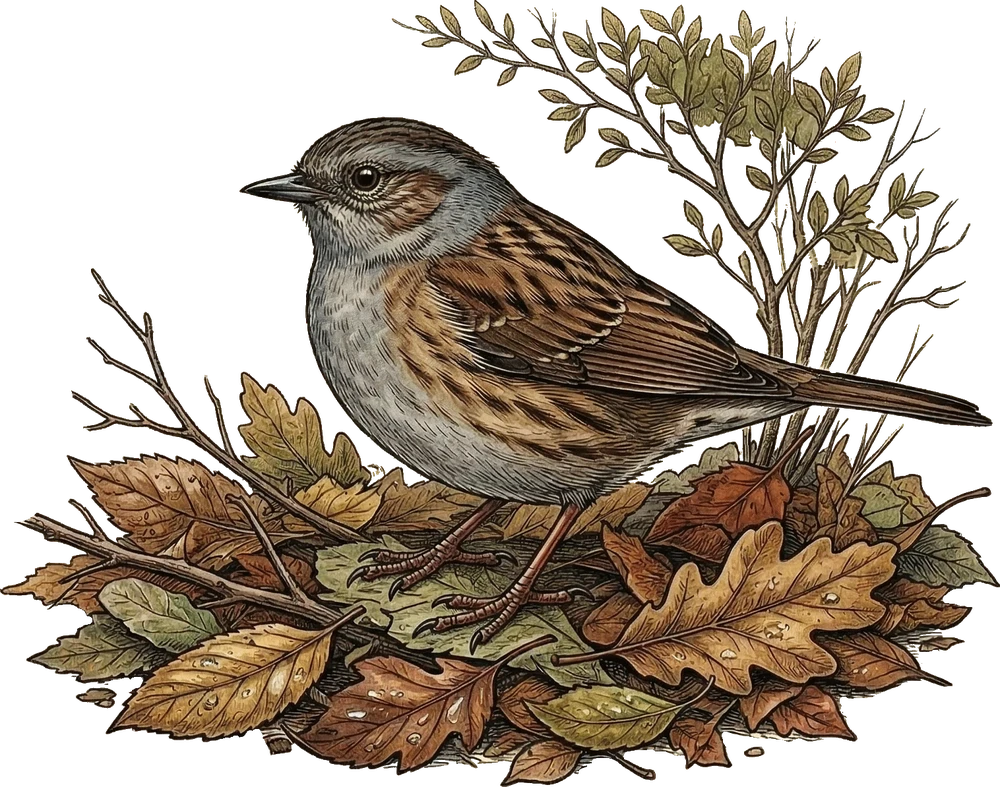
Dunnock
Prunella modularis
Genus ·
Accentors
Family ·
Accentors
Observation tips
Difficulty: MODERATE
Best time
🕒 Any
Activity
☀️ Diurnal
Best months
1
2
3
4
5
6
7
8
9
10
11
12
Observation habitat
Bird feederBushesForest undergrowth
Look for a grey-faced sparrow-like bird in the shadows of a hedge. Watch for the frequent wing-flicking behavior.
Stats
Wingspan19–21 cm
Weight16–25 g
Length13–15 cm
Lifespan wild2–9 yrs
Size
XS
S
M
L
XL
Nesting
Nest typeCup
Clutch size3–6 eggs
Incubation12–14 days
Breeding months
1
2
3
4
5
6
7
8
9
10
11
12
Regional Status (Europe)
LC
Least Concern (Europe)
IUCN Red List
MigrationPartial migratory
Social BehaviourSolitary
Diet: Omnivore
🫐Berries
🦗Insects
🌻Seeds
🕷️Spiders
🪱Worms
Habitat
🚜 Farmland🌲 Forest coniferous🌳 Forest deciduous🏡 Garden🏙️ Urban
✦ Fun Fact
Despite hiding their nests well, Dunnocks are regular hosts of the Common Cuckoo, which secretly lays an egg for them to incubate.

See Dunnock in the app.
Full encyclopedia, offline diary, AI identification - always with you.
Download on Google Play
Full encyclopedia, offline diary, AI identification - always with you.